
Non-Communicable Diseases
Rates of screening for non-communicable chronic diseases in asymptomatic populations are generally low in resource-constrained settings, leading to the development of advanced disease, with costly complications for patients and communities. Low screening rates are due in part to the fact that many screening tools are not accessible or usable in low-resource settings. Our team at GEAR is developing clinically effective, resource-efficient, and practically feasible screening and detection tools with the aim of reducing preventable deaths by making disease diagnosis more accessible to hundreds of millions of patients in low- and middle-income countries (LMICs).
Non-invasive consumable-free diabetes screening
Of the 830 million people with diabetes worldwide, 80% live in LMICs. Undetected diabetes allows chronically high blood sugar to silently damage critical organs. Early detection and management are crucial to prevent life-threatening complications. Large-scale diabetes screening can be facilitated by extension worker networks in LMICs if equipped with a non-invasive and consumable-free diabetes screening tool, but no such tool exists. We are developing a non-invasive, consumable-free diabetes screening method and device to enable large-scale population screening and ultimately reduce global human and economic costs of diabetes.
Low-cost wide-angle retinal imaging
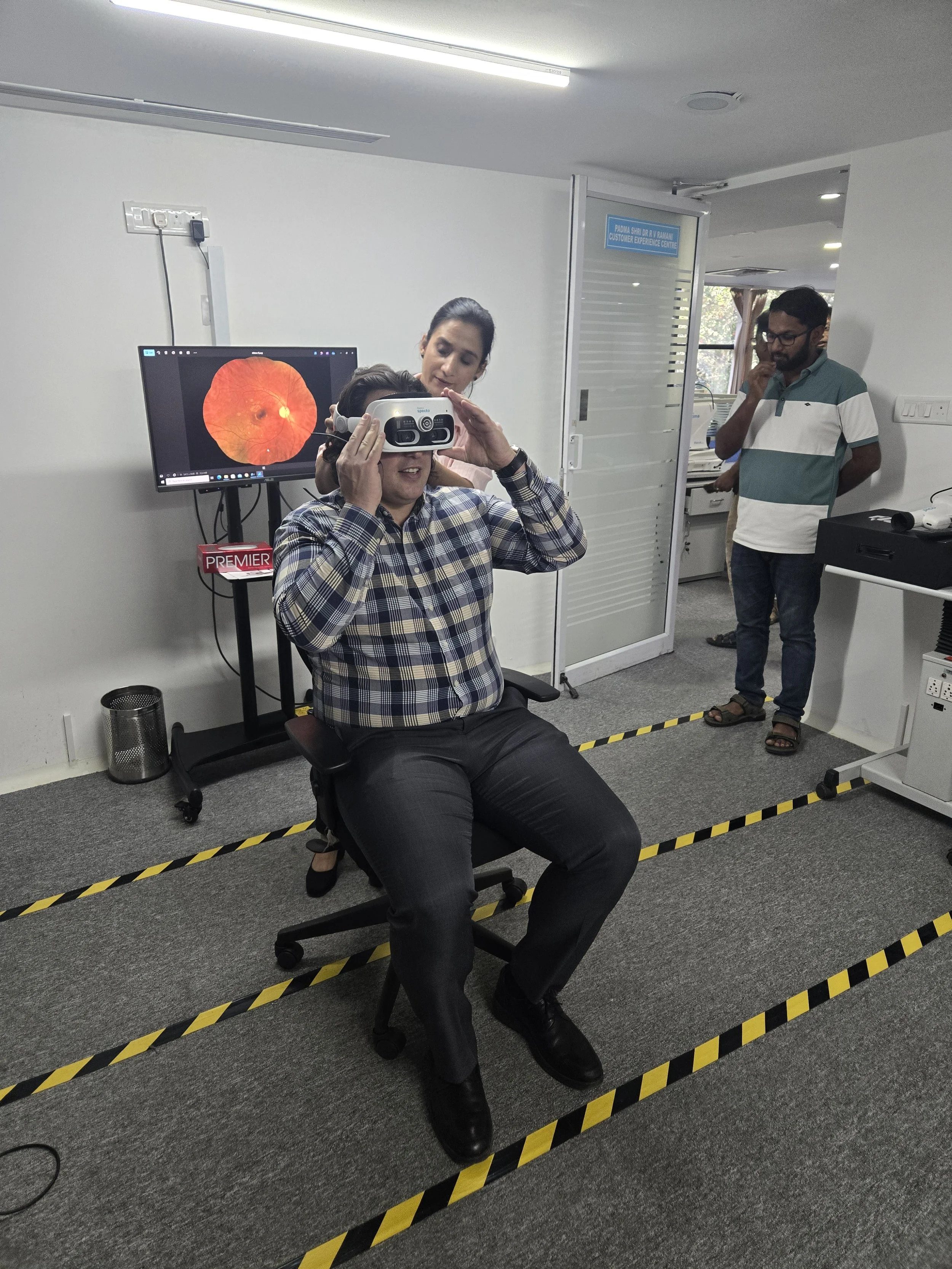
Over one in four people with diabetes are at risk of going blind due to the development of diabetic retinopathy (DR). DR is the most common cause of preventable blindness in adults, despite the existence of multiple interventions to treat early stages of the disease. Early diagnosis of DR is key to preventing visual impairment, which is achieved through visualization of the peripheral retina by wide-angle fundus (retinal) imaging. We are developing a low-cost wide-angle fundus camera for large-scale screening of people outside of specialized eye clinics, enabling widespread availability of vision-saving care.
Minimally invasive cervical cancer screening
Cervical cancer is the 4th most common cancer for women globally, and 90% of cases are in LMICs. While cervical cancer is successfully treatable if caught early through screening, mortality rates remain high in LMICs. A major deterrent of screening cited by women across countries and cultures is the uncomfortable and embarrassing exam. There is a need for a cervical cancer screening tool that minimizes discomfort while achieving clinical efficacy.
Early Shock Detection
Sepsis is a leading cause of death worldwide, accounting for 20% of annual deaths. An estimated 85% of these deaths occur in LMICs. Left untreated, sepsis progresses into circulatory shock. Established standards of care for shock detection in general hospital wards rely heavily on qualitative observations and clinical judgement. This need for repeated expert evaluation is a bottleneck for care, especially in LMICs, limiting the timeliness and efficacy of treatment. We aim to develop a device to noninvasively monitor perfusion status in order to provide automated, timely alerts of impending shock.
Publications
Peer-Reviewed Conference Articles
Early Value Chain Analysis for Medical Devices for Low- and Middle-Income Countries
Reddie, M., Vadhula, S. R., Yin, R. T., and Winter V, A. G., Proceedings of the ASME 2025 Design of Medical Devices Conference, Minneapolis, MN, USA (2025)